- 24/7
Customer Service
- ISO 9001
Certification Company
- Qualified
Expert Professional

O RINGS
- Industrial
O RINGS
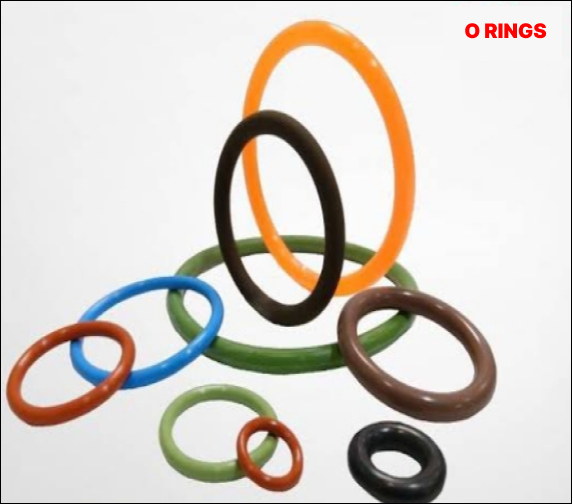
An O-ring is one of the simplest types of seal available, and despite its basic design, its applications and usefulness are unrivalled. Used to prevent leakages, these simple seals can be used in anything from cylinders to pumps, connectors to vacuum seals. They can be manufactured from synthetic rubbers such as nitrile rubber or PTFE, from thermoplastics such as TPU or TPE styrenes, or from specialist materials for chemical compatibility.
The O-ring itself is pretty self-explanatory; it’s essentially a ‘O’ shaped ring of material which is used as a gasket. It is designed to sit within a groove and to be compressed during assembly between the component parts which then, thanks to the dynamics of the shape of the O-ring, creates a perfect seal.
How do O-rings work to create a seal?
In any type of machinery, you’ll undoubtedly find an O-ring or two. They are inexpensive, reliable and easy to use, which makes them infinitely popular in the design of both static and dynamic processes. The can stand thousands of PSI of pressure, but how do O-rings work to do this?
The mechanics of an O-ring are relatively simple; here’s how they work:
- The O-ring is manufactured alongside (usually) metallic hardware to fit perfectly within the glad of the assembly.
- During assembly, the O-ring is fitted within the glad and is compressed as the second piece of hardware is fitted into place.
- This compression diametrically squeezes the seal, resulting in a force which ensures full contact with both the inner and outer walls of the gland.
- With no pressure, the natural resilience of the O-ring material will create a perfect seal and stop fluid from passing the barrier. When fluid begins to put pressure on the O-ring, the ring is pushed against the wall of the gland on the low-pressure side, therefore increasing the strength of the seal.
- When pressure is released, the properties of the O-ring material allow it to return to its original shape, maintaining the seal and the integrity of the O-ring.
The mechanics of how O-rings work might sound complicated when explained like this, but the result is simple to understand; no leaks. The simplicity of the O-ring is what has contributed to the longevity and popularity of this product.
Related Product